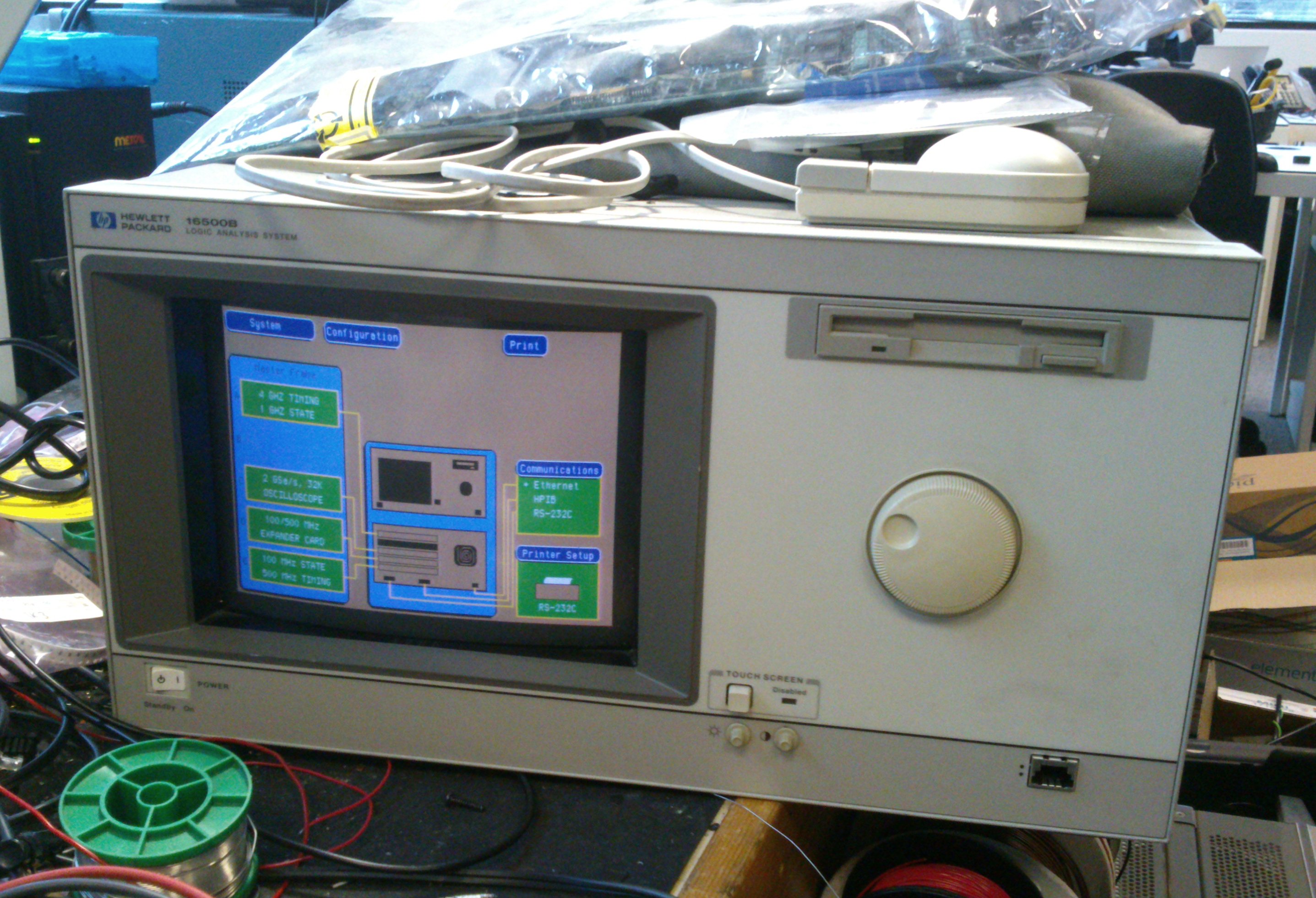
My HP 16500A has only 1MB of RAM, which isn’t enough to run the system software for the 16550A logic analyzer module I’d like to use in it. Apparently there was a later version of the 16500A which had 2.5MB of RAM, but I haven’t got one of those. Just my luck. Trying to load the 16550A system software results in an error message:

This got me thinking. Might I be able to upgrade the memory? The RAM on the 16500A processor board is eight 1Mbit DRAM chips, soldered in:

I looked up the data sheet for the chips, TMS44C256. It indicates that pin 5 isn’t used. However, on larger (4Mbit) chips, pin 5 is another address line. Intriguingly, pin 5 is wired up on this processor board, implying that the hardware is ready for larger RAM chips. I have no idea whether the software is ready, but there’s only one way to find out. It’s got to be worth a try, hasn’t it?
Unfortunately I couldn’t find any 4Mbit DRAM chips in the DIL package to fit this board, and making or buying adapters for surface mount chips seems like a pain. However, there is another approach: old PCs are full of SIMM memory modules which have electrically suitable chips on them, and they’re already wired conveniently together. If I removed the 1Mbit DRAM chips from the processor board and string wires from the resulting holes to a SIMM, I might have a 4MB 16500A. Or a doorstop.
To change DRAM chips requires knowing how the address and data buses are wired, and how the RAS and CAS strobe lines are connected to the various chips. RAS and CAS are effectively chip enables, so they can be considered to be part of the address for wiring purposes. A bit of reverse engineering with a continuity tester resulted in this sketch of how the RAM is wired up:

If I do a similar job on a suitable 72-pin 4MB SIMM, it should be possible to match up the wires and see what happens. There’s a handy vintage SIMM data sheet I found here:
http://www.pjrc.com/mp3/simm/datasheet.html
which should be a good start. What can possibly go wrong?


 martinjonestechnology